For travelers starting their Himalayan journey in Kathmandu, a Bhutan tour from Kathmandu is one of the easiest ways to add another fascinating Himalayan country to the trip. Bhutan is only a short flight from Nepal, yet the experience feels completely different, with its fortress monasteries, mountain valleys, Buddhist traditions, traditional architecture, and distinctive approach to tourism.
While short Bhutan tours usually concentrate on Paro and Thimphu, a longer journey allows you to travel deeper into the country. A 9-day Bhutan tour covering Paro, Thimphu, Gangtey, Bumthang, and Punakha offers a much broader picture of Bhutan, combining major cultural landmarks with quieter valleys, historic dzongs, monasteries, villages, and mountain scenery.
This guide explains how to travel from Kathmandu to Bhutan, what the 9-day itinerary looks like, how much the tour costs, what is included, the best time to visit, what the trip is like physically, and what you should know before booking.
Why Take a Bhutan Tour from Kathmandu?
Kathmandu is an important Himalayan travel hub, making it particularly convenient for travelers who are already visiting Nepal.
The Kathmandu–Paro flight is short compared with many international journeys, and the route itself can be one of the most memorable parts of the trip. On clear days, passengers can enjoy views of the Himalayan range before descending into Paro Valley. A Bhutan trip also complements a Nepal itinerary well. You can spend several days exploring Kathmandu's temples and heritage sites before flying to Bhutan, or visit Bhutan after completing a Nepal trekking adventure.
A longer Bhutan itinerary then gives you the opportunity to experience more than the familiar Paro–Thimphu circuit.
Getting from Kathmandu to Bhutan
Kathmandu to Paro by Flight
The most practical way to begin a Bhutan tour from Kathmandu is by flying directly to Paro.
Two airlines commonly associated with the Kathmandu–Paro route are:
-
Drukair (Royal Bhutan Airlines)
-
Bhutan Airlines
The flight takes roughly 1 to 1.5 hours, although schedules and operating days vary by season.
Because flight schedules can change, travelers should confirm the exact operating dates before booking their Bhutan itinerary.
What Is the Kathmandu–Paro Flight Like?
The flight is relatively short, but the scenery can be spectacular. On clear days, the Himalayan panorama provides a dramatic introduction to Bhutan.
The flight also lands at Paro International Airport, one of the world's most distinctive mountain airports. The surrounding mountains and valley make the arrival feel very different from a conventional international airport experience.
Should You Visit Kathmandu Before Bhutan?
If you have additional time, Kathmandu is worth exploring before or after your Bhutan trip.
Popular places include:
-
Kathmandu Durbar Square
-
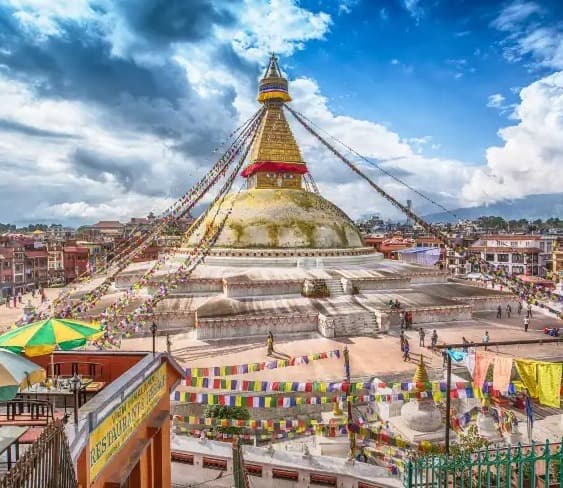
Boudhanath Stupa
-
Swayambhunath
-
Pashupatinath Temple
-
Patan Durbar Square
-
Bhaktapur Durbar Square
This makes it possible to combine two very different Himalayan cultural experiences in one holiday.
Bhutan Tour from Kathmandu: Trip Overview
|
Detail |
Information |
|
Destination |
Bhutan |
|
Gateway |
Kathmandu, Nepal |
|
Duration |
9 Days / 8 Nights |
|
Main Regions |
Paro, Thimphu, Gangtey, Bumthang, Punakha |
|
Activities |
Cultural sightseeing, village visits, hiking |
|
Accommodation |
3-, 4-, or 5-star hotels |
|
Highest Point |
3,120m at Tiger's Nest |
|
Transportation |
Private vehicle within Bhutan |
|
Meals |
Breakfast, Lunch & Dinner |
|
Guide |
English-speaking guide |
|
Group Size |
Minimum 1 person |
|
Starting Price |
From US$1,649 per person for larger groups, standard package |
The Kathmandu–Paro international flight is separate from the Bhutan ground package price.
What to Expect on a 9-Day Bhutan Tour
A 9-day itinerary gives you considerably more time than a typical short Bhutan holiday.
Instead of staying primarily around Paro and Thimphu, the route travels east toward Gangtey and Bumthang before returning through Punakha and finally reaching Paro.
That means you should expect some long driving days.
The journey includes:
-
Historic cities and dzongs
-
Buddhist monasteries and temples
-
Mountain passes
-
High valleys
-
Forested roads
-
Rural villages
-
Traditional crafts and textiles
-
Short and moderate hikes
-
Scenic river valleys
-
The famous Tiger's Nest hike
One of the advantages of traveling slowly through Bhutan is that the journey between destinations becomes part of the experience. Roads wind through forests and mountain passes, with the landscape changing significantly as you move between western and central Bhutan.
Best Places to Visit on a Bhutan Tour from Kathmandu
1. Thimphu
Thimphu is Bhutan's capital and one of the first places you encounter after arriving in the country.
The city combines modern government buildings and shops with traditional Bhutanese architecture and Buddhist landmarks.
Important attractions include:
-
Buddha Dordenma
-
King's Memorial Chorten
-
Tashichho Dzong
-
National Library
-
Institute for Zorig Chusum
-
Textile Museum
-
Local Crafts Bazaar
2. Buddha Dordenma
The Buddha Dordenma statue at Kuensel Phodrang is one of Thimphu's most recognizable landmarks.
The gilded bronze Buddha stands approximately 51.5 meters high and overlooks the capital.
The viewpoint also provides broad views across the Thimphu Valley.
3. Tashichho Dzong
Tashichho Dzong, often translated as the Fortress of Glorious Religion, is an important administrative and religious complex in Thimphu.
The complex has strong connections with Bhutan's government and central monastic institutions and is one of the city's most impressive examples of traditional architecture.
4. Gangtey and Phobjikha Valley
The Phobjikha Valley offers a completely different atmosphere from Thimphu.
The broad valley is surrounded by mountains and is known for its natural environment and the seasonal arrival of black-necked cranes.
A visit here typically includes the Gangtey Nature Trail, Gangtey Goenpa, and the Black-Necked Crane Information Center.
For travelers interested in nature and rural Bhutan, Gangtey is one of the highlights of the itinerary.
5. Trongsa Dzong
Trongsa lies along the historic route through central Bhutan.
Its enormous dzong is dramatically positioned above the surrounding landscape and has played an important role in Bhutan's history.
The stop provides an opportunity to understand how Bhutan's dzongs functioned not only as religious centers but also as administrative and strategic strongholds.
6. Bumthang
Bumthang is often regarded as one of Bhutan's most important spiritual regions.
The valley contains numerous monasteries and sacred sites connected with Bhutanese Buddhist history.
Highlights include:
-
Jakar Dzong
-
Kurjey Lhakhang
-
Tharpaling Monastery
-
Mebar Tsho
-
Rural villages
-
Traditional textile workshops
Bumthang also gives visitors a chance to see a quieter and more rural side of Bhutan.
7. Punakha
Punakha sits at a much lower elevation than Gangtey and Bumthang, creating a noticeable change in climate and landscape.
The major attraction is Punakha Dzong, located at the confluence of the Mo Chhu and Pho Chhu rivers.
Other highlights include:
-
Chimi Lhakhang
-
Punakha Valley
-
Traditional villages
-
Dochula Pass
The contrast between the cold mountain valleys and warmer Punakha Valley is one of the most interesting aspects of the journey.
8. Paro and Tiger's Nest
The trip ends in Paro with Bhutan's most famous attraction: Taktshang Monastery, better known as Tiger's Nest.
The monastery is dramatically positioned on a cliff above Paro Valley and is reached by hiking through pine forest and mountain terrain.
The hike is one of the most physically demanding activities on the itinerary, but it is also one of the most memorable.
Detailed 9-Day Bhutan Tour Itinerary
Day 1: Kathmandu to Paro and Transfer to Thimphu
Your Bhutan journey begins with the flight from Kathmandu to Paro.
After immigration and arrival formalities, meet your Bhutanese guide and driver before beginning the scenic journey toward Thimphu.
The route passes through Chuzom, where rivers meet, before continuing toward Tamchog Lhakhang.
Depending on arrival time, you can explore Thimphu's main street and Local Crafts Bazaar in the evening.
Overnight: Thimphu
Meals: Dinner
Elevation: Approximately 2,200m to 2,334m
Day 2: Explore Thimphu
Spend a full day discovering Bhutan's capital.
The sightseeing program includes several cultural and historical attractions, such as:
-
National Library
-
Institute for Zorig Chusum
-
Textile Museum
-
Buddha Dordenma
-
King's Memorial Chorten
-
Tashichho Dzong
This is also a good day to learn about Bhutanese traditional arts, architecture, and daily life.
Overnight: Thimphu
Meals: Breakfast, Lunch & Dinner
Elevation: Approximately 2,334m
Day 3: Thimphu to Gangtey
Leave Thimphu and travel toward the Phobjikha Valley.
The road gradually enters a more mountainous environment, eventually reaching Gangtey.
After arrival, take the Gangtey Nature Trail, a relatively gentle walk through the valley.
The day can also include a visit to Gangtey Goenpa and the Black-Necked Crane Information Center.
Overnight: Gangtey
Meals: Breakfast, Lunch & Dinner
Elevation: Approximately 2,334m to 3,000m
Day 4: Gangtey to Bumthang via Trongsa
Continue toward central Bhutan.
One of the major stops is Trongsa Dzong, an enormous historic fortress overlooking the surrounding landscape.
After exploring Trongsa, continue toward Bumthang.
On arrival, visit sites such as Jakar Dzong and Kurjey Lhakhang, depending on available time.
Overnight: Bumthang
Meals: Breakfast, Lunch & Dinner
Elevation: Approximately 3,000m to 2,600m
Day 5: Explore Bumthang
Spend a full day exploring the spiritual and rural character of Bumthang.
The day can include a hike toward Tharpaling Monastery, followed by a visit to Mebar Tsho, also known as Burning Lake.
You can also explore nearby villages and traditional textile workshops.
Depending on availability and interest, visits to local attractions such as a brewery or cheese-making facility can add another dimension to the day.
Overnight: Bumthang
Meals: Breakfast, Lunch & Dinner
Elevation: Approximately 2,600m
Day 6: Bumthang to Punakha
This is one of the longer road journeys of the tour.
Travel west from Bumthang through changing mountain landscapes before descending toward the warmer Punakha Valley.
After reaching Punakha, visit Punakha Dzong, positioned at the confluence of two rivers.
The itinerary can also include the walk to Chimi Lhakhang through the surrounding agricultural landscape.
Overnight: Punakha
Meals: Breakfast, Lunch & Dinner
Elevation: Approximately 2,600m to 1,242m
Day 7: Punakha to Paro via Dochula
Leave Punakha and climb toward Dochula Pass, located at approximately 3,100 meters.
The pass is famous for its 108 chortens and panoramic Himalayan views when weather conditions are favorable.
Continue toward Paro, stopping around Simtokha before reaching the valley.
Once in Paro, visit Ta Dzong, home to the National Museum, followed by Rinpung Dzong.
Overnight: Paro
Meals: Breakfast, Lunch & Dinner
Elevation: Approximately 1,242m to 2,200m
Day 8: Tiger's Nest Hike
Day 8 is the main hiking day of the trip.
Begin the ascent toward Taktshang Monastery, commonly called Tiger's Nest.
The trail climbs through pine forest and passes prayer flags and mountain viewpoints before reaching the monastery complex.
The hike generally takes around 4.5–5 hours round trip, depending on pace and stops.
After returning to Paro, visit Kyichu Lhakhang, one of Bhutan's important historic temples.
Overnight: Paro
Meals: Breakfast, Lunch & Dinner
Hiking: Approximately 4.5–5 hours round trip
Highest point: Approximately 3,120m
Day 9: Departure from Paro
Enjoy breakfast before transferring to Paro International Airport for your onward flight.
For travelers returning to Nepal, this is the point where the Bhutan portion of the journey ends before the flight back to Kathmandu.
Meals: Breakfast
Airport transfer: Approximately 15–20 minutes
Bhutan Tour Altitude Guide
|
Location |
Approx. Elevation |
Main Highlight |
|
Paro |
2,200m / 7,218ft |
Tiger's Nest |
|
Thimphu |
2,334m / 7,657ft |
Tashichho Dzong |
|
Bumthang |
2,600m / 8,530ft |
Jakar Dzong |
|
Gangtey |
3,000m / 9,843ft |
Phobjikha Valley |
|
Punakha |
1,242m / 4,075ft |
Punakha Dzong |
|
Tiger's Nest |
3,120m / 10,236ft |
Taktshang Monastery |
Because the itinerary moves between valleys of different elevations, the temperature and landscape can change considerably from one day to the next.
Bhutan Tour from Kathmandu Cost
The cost of a Bhutan tour depends heavily on hotel category, group size, and the services included.
For this 9-day itinerary, the package options are:
|
Package |
Hotel Category |
Starting Price – Larger Group |
Solo Traveler |
|
Standard |
3-star |
US$1,649 |
US$2,529 |
|
Deluxe |
4-star |
US$1,879 |
US$2,879 |
|
Luxury |
5-star |
US$6,359 |
US$11,068 |
Prices can decrease as the number of travelers increases, with larger groups receiving lower per-person rates.
Important: Kathmandu–Paro Airfare
The above package prices do not include international airfare between Kathmandu and Paro.
When calculating your complete Bhutan trip budget, remember to consider:
-
Kathmandu–Paro airfare
-
Paro–Kathmandu airfare
-
Bhutan tour package
-
Personal expenses
-
Travel insurance
-
Drinks and beverages
-
Tips
-
Shopping
-
Optional activities
What Is Included in the Bhutan Tour Cost?
The ground package includes:
-
Hotel accommodation according to the selected category
-
Breakfast and dinner at hotels
-
Lunch at local tourist restaurants
-
Private vehicle for transportation and sightseeing
-
English-speaking guide
-
Sustainable Development Fee (SDF)
-
Government royalties and applicable taxes
-
Entrance and monument fees
-
Two bottles of water per person per day
-
Bhutan visa fee
The current Bhutan tourism system lists the SDF for adults at US$100 per day, while a separate one-time visa application fee of US$40 applies to most visitors.
What Is Not Included?
The following expenses are generally separate:
-
Kathmandu–Paro international airfare
-
Airport taxes where applicable
-
Travel insurance
-
Medical expenses
-
Alcoholic and non-alcoholic beverages
-
Personal shopping
-
Laundry
-
Telephone expenses
-
Tips
-
Camera or other personal fees where applicable
-
Optional Traditional Mask Dance & Cultural Show
-
Hot stone bath
-
Single supplement
The package information lists the optional Traditional Mask Dance & Cultural Show at US$150 per group and the single supplement at US$230 per person.
Is the Bhutan Tour Physically Difficult?
Most of the itinerary is relatively easy.
You spend much of the trip visiting:
-
Dzongs
-
Temples
-
Museums
-
Villages
-
Cultural sites
-
Viewpoints
However, there are two more active parts of the journey.
Gangtey Nature Trail
The Gangtey walk is generally moderate and takes place in a higher-altitude environment.
Tiger's Nest
The Tiger's Nest hike is the toughest physical activity on the itinerary.
The trail involves a significant uphill climb, uneven surfaces, and stairs. Travelers should be comfortable walking for several hours.
You do not need to be an experienced trekker, but regular walking and cardiovascular exercise before the trip can make the experience considerably easier.
Best Time for a Bhutan Tour from Kathmandu
Bhutan can be visited throughout the year, but each season offers a different experience.
|
Season |
Months |
What to Expect |
|
Spring |
March–May |
Mild weather, flowers and festivals |
|
Summer/Monsoon |
June–August |
Rain, greener valleys and possible road disruptions |
|
Autumn |
September–November |
Clear skies and excellent mountain views |
|
Winter |
December–February |
Cold Gangtey/Bumthang, milder Punakha |
Spring
Spring is particularly attractive for travelers interested in flowers, pleasant temperatures, and cultural festivals.
Summer
The monsoon can bring significant rainfall, particularly in lower valleys. Roads may be affected by weather, so flexibility is useful.
Autumn
September through November is one of the most popular periods because of generally clear skies and excellent Himalayan visibility.
Winter
Winter can be cold in Gangtey and Bumthang, but Punakha and other lower-altitude destinations can remain considerably warmer.
Bhutan Temperature Guide
|
Destination |
January |
May |
September |
|
Thimphu |
12 / -2°C |
22 / 11°C |
23 / 13°C |
|
Gangtey |
7 / -5°C |
17 / 7°C |
18 / 10°C |
|
Bumthang |
9 / -3°C |
19 / 9°C |
21 / 12°C |
|
Punakha |
16 / 4°C |
29 / 17°C |
30 / 20°C |
|
Paro |
10 / -2°C |
23 / 12°C |
24 / 14°C |
These are useful general planning figures rather than guaranteed daily temperatures.
One of the biggest differences you'll notice is between Gangtey and Punakha. Gangtey can be cold because of its elevation, while Punakha has a warmer subtropical climate.
Bhutan Visa for Travelers from Kathmandu
Bhutan has a separate immigration and visa process from Nepal.
Most international visitors need a Bhutan visa before traveling. Visitors from India, Bangladesh, and the Maldives follow separate permit or visa procedures. The official Bhutan Travel site currently states that most visitors need to pay a US$40 one-time, non-refundable visa application fee, in addition to the applicable SDF.
When traveling with a tour operator, the operator can assist with the visa application using the required passport information and documents.
Always check the latest requirements before departure because immigration policies can change.
Do You Need Travel Insurance for Bhutan?
Travel insurance is strongly recommended, but it is no longer a mandatory requirement for Bhutan visa processing.
Bhutan officially withdrew the mandatory travel-insurance requirement on April 23, 2024, while continuing to recommend insurance as a precaution for international travelers.
For a multi-region Bhutan trip, comprehensive insurance is particularly sensible. Look for coverage that includes:
-
Medical treatment
-
Emergency evacuation
-
Trip interruption
-
Flight delays or cancellations
-
Lost baggage
-
Emergency repatriation
Transportation During the Bhutan Tour
Transportation within Bhutan is provided by private vehicle.
Vehicle type generally depends on group size:
-
1–2 travelers: SUV
-
3–4 travelers: Hyundai H1 or similar
-
5–8 travelers: Toyota HiAce or similar
-
Larger groups: Coaster or comparable vehicle
Because the itinerary includes several long road journeys, a comfortable vehicle can make a significant difference.
The road itself is part of the experience, with mountain scenery changing from high valleys and forests to warmer subtropical landscapes.
Money and Payments in Bhutan
The Bhutanese currency is the Ngultrum (BTN), which is pegged to the Indian Rupee.
Cards are increasingly useful in Bhutan, particularly in larger hotels and businesses, but carrying some cash remains sensible when traveling through smaller towns and rural areas.
The official Bhutan tourism website recommends travelers enable international transactions on their cards, notify their banks before traveling, and check card network and withdrawal limits.
For a journey through Gangtey and Bumthang, carrying some backup cash is a good idea.
Internet and Mobile Connectivity
Wi-Fi is available at many hotels, although connectivity can be less reliable in remote areas.
Travelers can also obtain a local SIM in Bhutan. Connectivity is generally better around major towns than in remote mountain valleys.
If staying in Gangtey or traveling through central Bhutan, expect occasional periods where internet access is slower or less consistent.
Tipping in Bhutan
Tipping is not a fixed requirement, but many travelers choose to tip their guide and driver when they are satisfied with the service.
A commonly suggested guideline for this itinerary is approximately:
-
Guide: US$10–15 per day per group
-
Driver: US$8–10 per day per group
The amount can be adjusted according to group size, service quality, and trip duration.
Bhutanese Etiquette and Photography
Bhutan has a deeply rooted Buddhist culture, so respectful behavior is important.
When visiting temples, monasteries and dzongs:
-
Dress modestly.
-
Cover shoulders and knees where appropriate.
-
Remove hats or caps inside religious buildings when requested.
-
Walk clockwise around religious structures where appropriate.
-
Avoid loud conversations inside religious sites.
-
Ask before photographing local people.
-
Follow instructions regarding photography inside temples.
-
Do not touch religious objects without permission.
The goal is simple: treat religious sites as places of active worship rather than ordinary tourist attractions.
What Should You Pack for a Bhutan Tour from Kathmandu?
Because this itinerary crosses several elevations and climate zones, layering is the best approach.
Recommended items
-
Comfortable walking shoes
-
Lightweight hiking shoes for Tiger's Nest
-
Warm fleece or jacket
-
Waterproof outer layer
-
Comfortable trousers
-
Modest clothing for temples
-
Sun hat
-
Sunglasses
-
Sunscreen
-
Reusable water bottle
-
Small daypack
-
Personal medication
-
Power bank
-
Travel adapter
-
Passport and travel documents
If traveling during winter, add warmer layers for Gangtey and Bumthang.
Is 9 Days Enough to Explore Bhutan?
Nine days provides a much broader Bhutan experience than a short Paro–Thimphu tour.
You will experience:
Western Bhutan
-
Paro
-
Thimphu
Central Bhutan
-
Gangtey
-
Trongsa
-
Bumthang
Western/Central transition
-
Punakha
-
Dochula
The itinerary still does not cover every part of Bhutan. Eastern Bhutan and longer trekking routes require additional time.
However, for travelers who want a combination of culture, history, nature, mountain scenery, and moderate hiking, nine days provides a strong balance.
Who Is This Bhutan Tour Best For?
This itinerary is particularly suitable for:
-
Travelers already visiting Kathmandu
-
Couples
-
Families with active members
-
Small private groups
-
Culture enthusiasts
-
Photography enthusiasts
-
First-time Bhutan visitors
-
Travelers interested in Buddhist heritage
-
People who want to explore beyond Paro and Thimphu
-
Travelers who prefer scenic road journeys
It may be less suitable for travelers who dislike long mountain drives or want a very relaxed holiday with minimal travel between destinations.
9-Day Bhutan Tour vs Shorter Tours
|
Tour Length |
Main Focus |
Best For |
|
4 Days |
Paro & Thimphu |
Very limited time |
|
5 Days |
Paro & Thimphu |
Relaxed short cultural trip |
|
7 Days |
Western Bhutan + Punakha |
More sightseeing without central Bhutan |
|
9 Days |
Paro, Thimphu, Gangtey, Bumthang & Punakha |
Comprehensive cultural experience |
|
Longer |
Bhutan + trekking/remote regions |
Travelers with more time |
The major advantage of the 9-day itinerary is that it goes beyond the country's most frequently visited western destinations.
Bhutan Tour from Kathmandu Booking Guide
Planning the trip is easiest when you separate the journey into two parts: international flights and the Bhutan ground package.
Step 1: Choose Your Travel Dates
Spring and autumn are particularly popular, so early planning is recommended.
Step 2: Check Kathmandu–Paro Flights
Flight schedules can vary depending on the season and operating schedule. Confirm the available flights before finalizing your travel dates.
Step 3: Select Your Hotel Category
Choose between:
-
Standard 3-star
-
Deluxe 4-star
-
Luxury 5-star
Your choice has a significant effect on the overall package price.
Step 4: Confirm Your Bhutan Visa
Provide the required passport information to your tour operator or complete the official process yourself.
Step 5: Arrange Travel Insurance
Although it is not currently mandatory, comprehensive travel insurance is strongly recommended.
Step 6: Confirm the Full Cost
Remember to calculate both the Bhutan package and the Kathmandu–Paro airfare when preparing your overall budget.
Step 7: Prepare for the Mountain Journey
Pack layers and comfortable walking footwear because the itinerary moves between warm low valleys and colder high-altitude areas.
5-Day vs 9-Day Bhutan Tour
If your vacation is limited, a 5-day Bhutan cultural tour focusing on Paro and Thimphu is a practical option.
However, if you have nine days available, the difference is substantial.
The longer itinerary adds:
-
Gangtey
-
Phobjikha Valley
-
Trongsa
-
Bumthang
-
Tharpaling
-
Mebar Tsho
-
Punakha
-
Dochula Pass
Instead of simply visiting Bhutan's most famous western landmarks, you get a better sense of the country's geographic and cultural diversity.
Can You Combine Nepal and Bhutan in One Trip?
Yes, and this is one of the biggest advantages of starting in Kathmandu.
A traveler can create a Himalayan holiday combining:
Kathmandu → Bhutan → Kathmandu
or build a longer itinerary around Nepal and Bhutan.
For example, you could spend several days exploring Kathmandu before flying to Paro, complete the 9-day Bhutan itinerary, and then return to Nepal for additional sightseeing or a trekking adventure.
This combination is particularly attractive for international travelers who want to experience two Himalayan cultures in one vacation.
Final Thoughts: Is a Bhutan Tour from Kathmandu Worth It?
A Bhutan tour from Kathmandu is a great way to experience two unique Himalayan destinations in one journey. Bhutan offers peaceful valleys, ancient monasteries, historic dzongs, and beautiful mountain scenery.
For travelers who want to explore more than Paro and Thimphu, Himalayan Planet Adventures offers the Bhutan Tour: Paro, Thimphu & Bumthang. This journey combines cultural experiences, scenic landscapes, historic sites, and the famous Tiger’s Nest hike.
With 9 days to explore, you can enjoy Bhutan at a comfortable pace while discovering its culture, nature, and traditional way of life. It is an excellent choice for travelers looking for a memorable Himalayan experience beyond the usual tourist routes.
Frequently Asked Questions
Can I travel to Bhutan directly from Kathmandu?
Yes. Direct Kathmandu–Paro flights are available on scheduled services, although operating frequency varies. Always confirm the flight schedule for your travel dates before booking.
How long is the flight from Kathmandu to Paro?
The flight generally takes around 1 to 1.5 hours, depending on operating conditions and the specific flight.
Is airfare from Kathmandu included in the Bhutan tour price?
No. The 9-day ground package price is separate from the international Kathmandu–Paro and Paro–Kathmandu airfare.
How much does a 9-day Bhutan tour from Kathmandu cost?
The supplied package pricing starts at approximately US$1,649 per person for larger groups in the standard category. Solo travelers and higher hotel categories cost more.
What is the highest point of the tour?
Tiger's Nest reaches approximately 3,120 meters, while Gangtey is around 3,000 meters.
Is the Tiger's Nest hike difficult?
It is the most demanding activity on the itinerary. You should be comfortable walking uphill for several hours over uneven terrain.
Is travel insurance mandatory for Bhutan?
No. Bhutan lifted the mandatory travel-insurance requirement in April 2024, although official Bhutan tourism guidance strongly recommends having insurance.
Do I need a Bhutan visa?
Most international visitors need a visa before traveling to Bhutan. Visitors from India, Bangladesh, and the Maldives have separate entry procedures.
Is nine days enough for Bhutan?
Nine days is enough for a comprehensive western and central Bhutan journey, but not for seeing every part of the country.
Can I combine Bhutan with a Nepal trip?
Absolutely. Kathmandu makes a convenient starting point for a Nepal-and-Bhutan Himalayan itinerary.