
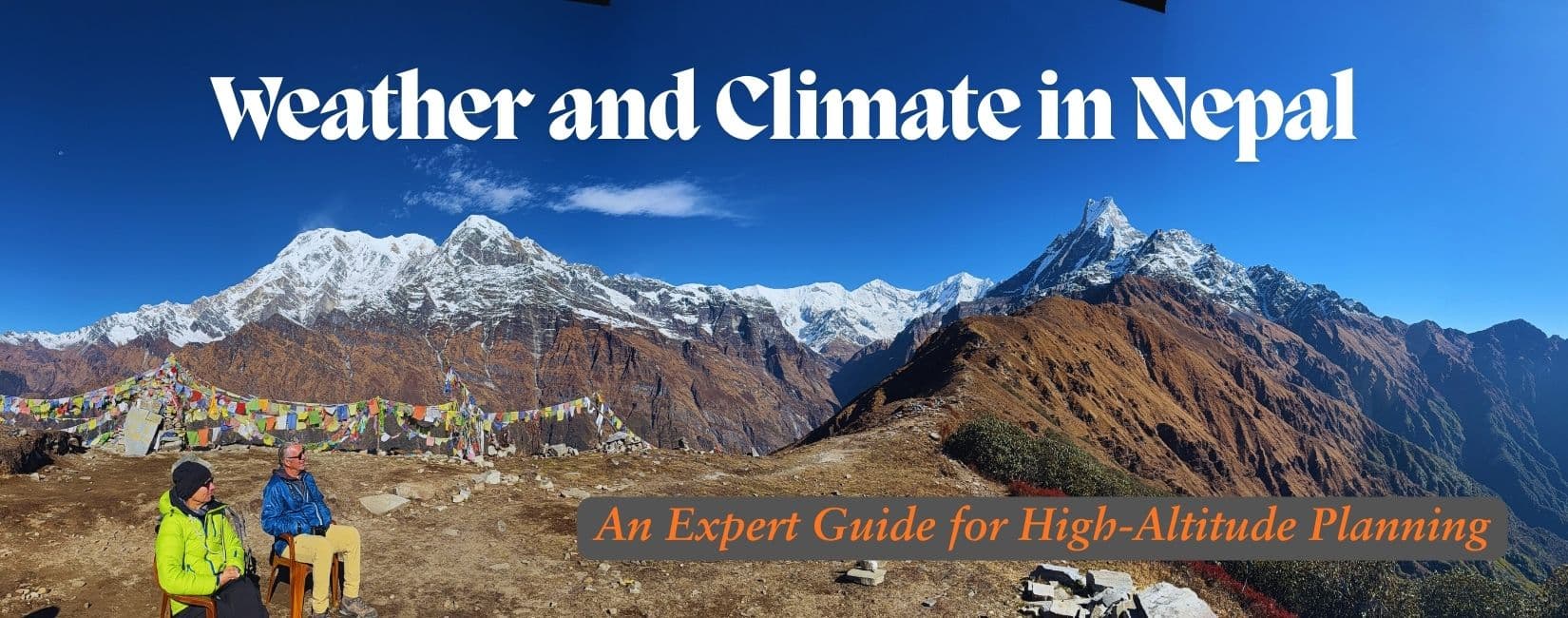
Understanding the weather and climate in Nepal requires more than a general forecast; it requires an appreciation for the country’s dramatic vertical geography. Within a span of 150 km, the elevation rises from 60m in the Terai to 8,848.86m at the summit of Everest. This creates a spectrum of micro-climates ranging from tropical heat to arctic cold.
As a Kathmandu-based agency, we track these shifts daily to ensure the safety of our expeditions and the success of our trekkers.
Seasonal Breakdown: When to Visit
Nepal experiences four distinct seasons, each offering a different technical environment for trekking and touring.
|
Season |
Months |
General Conditions |
Trekking Suitability |
|
Autumn |
Sept – Nov |
Crisp air, stable skies, post-monsoon clarity. |
Peak: Ideal for all high-altitude treks and passes. |
|
Winter |
Dec – Feb |
Dry, clear days; extreme cold at night above 4,000m. |
Niche: Excellent for lower treks; high passes may close. |
|
Spring |
Mar – May |
Rising temperatures, hazy afternoons, blooming flora. |
Peak: Primary climbing season for 8,000m peaks. |
|
Monsoon |
June – Aug |
High humidity, heavy rain, cloud-covered peaks. |
Specialized: Restricted to Rain Shadow areas like Mustang. |
Technical Seasonal Insights
Autumn: The Post-Monsoon Gold Standard
The period from late September through November offers the highest post-monsoon visibility for mountain photography. After the summer rains, the atmosphere is scrubbed clean of dust.
- Why it matters: This is the most reliable window for the Everest region. Lukla flight cancellations weather patterns are statistically at their lowest, ensuring your itinerary stays on track.
- Local Insight: While days are a comfortable 18℃ in the valleys, temperatures at Everest Base Camp (5,364m) routinely drop to -15℃ at night.
Spring: The Rhododendron and Climbing Window
During the Nepal trekking seasons rhododendron bloom, trails between 2,000m and 3,500m are transformed into a botanical gallery.
- Conditions: Mornings are typically clear, but afternoon convection clouds are common.
- High Altitude: This is the preferred time for the Annapurna Region Treks espically Annapurna Circuit as the Thorong La Pass weather conditions begin to stabilize after the winter snows melt.
Winter: The "Bluebird" Off-Season
Many ask, "Is it too cold to trek Nepal in January?" While the high Himalayas see heavy snowfall above 3,000m, the lower hills remain beautiful.
- The Benefit: You will have world-class viewpoints like Poon Hill almost entirely to yourself.
- Safety Note: We closely monitor the Mardi Himal snow level during this time, as sudden winter storms can make ridge trails challenging without crampons.
Summer/Monsoon: Navigating the Rain Shadow
While the rest of the country experiences heavy rain and potential landslides, the areas behind the Great Himalayan Range remain dry. Upper Mustang weather during monsoon is perfect for trekking, as the region receives less than 200mm of rain annually.
A Brief History of the Himalayan Seasons
Historically, the rhythm of life in Nepal has been dictated by these cycles. For centuries, the "Salt Trade" between Nepal and Tibet relied on the winter freeze to cross high passes and the summer monsoon to hydrate the middle hills for rice terrace farming.
Culturally, the end of the monsoon in October triggers Dashain and Tihar, Nepal's most significant festivals. This timing isn't accidental; the arrival of clear skies and the harvest traditionally signaled a time of celebration and travel long before the first trekking boots touched the soil in the 1950s.
Altitude vs. Temperature: The 6℃ Rule
To plan your packing, use the standard lapse rate: expect a temperature drop of approximately 6℃ for every 1,000m you ascend.
- Kathmandu (1,400m): 22℃
- Namche Bazaar (3,440m): 10℃
- Everest Base Camp (5,364m): -2℃ (Daytime)
Pro Tip from our Local Guides
"Don't rely solely on global weather apps like AccuWeather for the mountains; they often pull data from valley stations and miss high-altitude wind shifts. Himalayan weather forecast reliability is best managed by looking at the 'Mountain Forecast' specific to your peak's altitude. More importantly, always ask your guide about the 'Morning Wind'—in the Khumbu, if the wind picks up before 9:00 AM, it's often a sign that cloud cover will move in early, meaning you should push for that viewpoint an hour sooner than planned."
Gear Up for the Himalayas: Essential Packing by Activity and Season
The success of your trip depends heavily on your gear. Below is a targeted list of essentials categorized by activity and season, specifically curated from our two decades of experience in the weather and climate in Nepal.
1. Trekking and High-Altitude Hiking
This gear is designed for the standard "tea house" trekking model found in the most of the Himalayan region of Nepal.
Autumn/Spring (Standard Kit):
- Best month for Everest Base Camp trek packing: A 3-season sleeping bag (rated to -10℃), mid-weight down jacket, and 4 pairs of merino wool trekking socks.
- Base Layers: Moisture-wicking synthetic t-shirts and long-sleeve thermals.
- Footwear: Broken-in waterproof trekking boots with high ankle support.
Winter (December – February):
- Is it too cold to trek Nepal in January? Not if you have a 4-season sleeping bag (rated to -20℃), a heavyweight expedition down parka, and chemical hand/toe warmers.
- Accessories: Insulated "buff" or neck gaiter and a wind-stopper fleece hat that covers the ears.
Monsoon (June – August):
- Focus: Breathability and water resistance. High-quality Gore-Tex shell jacket, waterproof backpack cover, and leech-proof trekking socks for lower-altitude forest sections.
2. Peak Climbing and High-Altitude Expeditions
For those attempting 6,000m+ "Trekking Peaks" like Island Peak ,Mera Peak or Lobuche East Peak, technical hardware is required.
Technical Hardware:
- Climbing Harness: Lightweight alpine style with adjustable leg loops.
- Crampons: 12-point steel crampons compatible with your mountaineering boots.
- Ice Axe: Straight-shaft walking axe for glacier travel and arrest.
- Ascender (Jumar): Essential for fixed-line sections on the Thorong La Pass weather conditions or summit ridges.
High-Altitude Specifics:
- Footwear: Double mountaineering boots (plastic or insulated synthetic) for Island/Lobuche; Triple boots for 8,000m peaks.
- Vision: Category 4 glacier glasses to prevent snow blindness from intense UV glare.
- Gloves: A three-layer system: thin liner, insulated mid-layer, and waterproof expedition mittens.
3. Cultural Tours and Jungle Safaris
If you are exploring the valleys or the Terai plains, your packing should focus on comfort and cultural respect.
Kathmandu & Pokhara City Tours:
- Clothing: Modest attire (long pants or mid-calf skirts) for temple visits.
- Footwear: Comfortable walking shoes or trainers for the uneven cobblestone streets of Durbar Squares.
- Season-Specific: A light windbreaker for post-monsoon visibility for mountain photography mornings in Nagarkot.
Chitwan & Bardia Jungle Safaris:
- Colors: Neutral/earth tones (khaki, olive, brown) to avoid startling wildlife.
- Protection: High-strength insect repellent and long-sleeved shirts to prevent mosquito bites during the humid monsoon and post-monsoon months.
4. Essential Electronics & Documents
Regardless of your activity, these are the logistical staples we recommend for every guest.
- Power: A 20,000mAh power bank (cold weather drains batteries faster) and a universal Type C/D/M plug adapter.
- Hydration: Two 1-liter Nalgene bottles. We recommend these over bladders, as bladder tubes can freeze at high altitudes.
- Documents: Physical copies of your passport and trekking permits (TIMS/National Park) kept in a waterproof dry bag.
Pro Tip: The "Kathmandu Rental" Strategy
"Don't break the bank buying a -20℃ down jacket or a 4-season sleeping bag if you only plan to trek once. You can rent high-quality, sanitized expedition-grade gear right here in Thamel for roughly $2 to $5 per day. We can accompany you to our trusted gear shops upon your arrival to ensure you get the right fit and temperature rating for your specific route."